


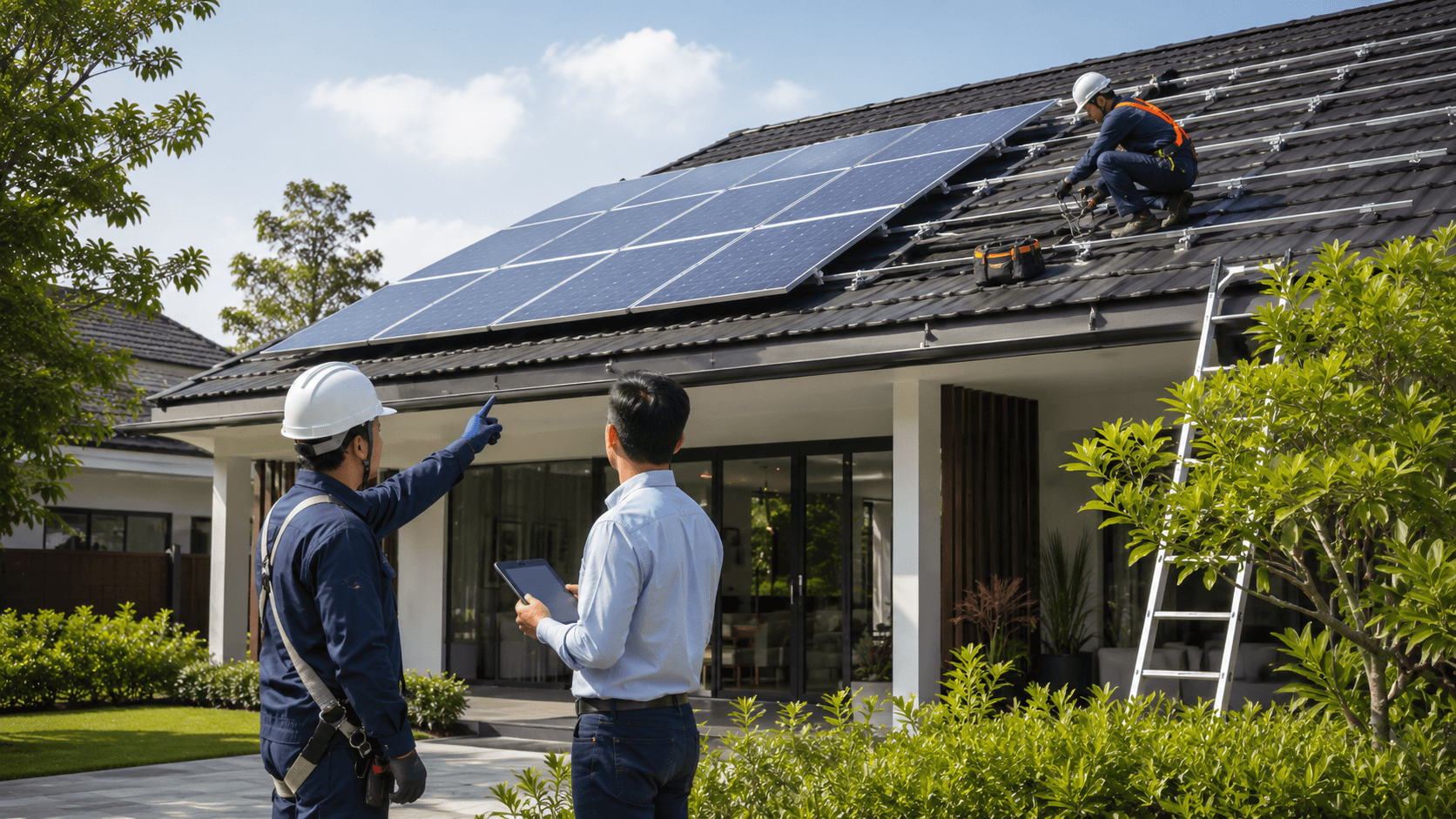
Solar panel installation in Malaysia has never been more accessible. With the Solar ATAP programme opening rooftop solar to residential consumers nationwide, and electricity tariffs continuing to rise, more homeowners and businesses are making the decision to invest in solar power. The financial case is compelling — reduced monthly bills, passive income through excess energy export, and a system that pays for itself over time.
But solar installation is not simply a matter of putting panels on a roof and plugging them in. The process involves structural assessments, regulatory approvals, electrical engineering, grid interconnection, and ongoing system monitoring. Done correctly by qualified professionals, it is a smooth and rewarding process. Done incorrectly — or by an unqualified installer — it can lead to safety hazards, poor system performance, voided warranties, and compliance issues with TNB and SEDA.
This guide covers what solar panel installation actually involves, the common challenges that arise for both residential and commercial properties, and why the expertise of a certified EPCC company makes all the difference.
Key Takeaways
Solar installation refers to the complete process of designing, supplying, and commissioning a solar photovoltaic (PV) system — transforming a property into one that generates its own clean electricity from sunlight.
A standard solar PV system consists of:
The installation process does not end when the physical work is complete. Grid interconnection approval from TNB, meter replacement, and final commissioning are all required before the system can operate legally and begin exporting energy under the Solar ATAP or SELCO programmes.
Understanding the full process helps set realistic expectations around timelines and what your installer is responsible for.
Step 1 — Initial Consultation and Site Assessment
Your solar provider evaluates your property, reviews your electricity bills, assesses your roof structure and orientation, and identifies any shading or electrical infrastructure limitations. This forms the basis for the system design.
Step 2 — System Design and Proposal
The installer produces a detailed system proposal including panel layout, system capacity in kWp, expected annual energy generation, bill savings projection, and return on investment timeline.
Step 3 — SEDA Application and Approval
For Solar ATAP, your installer submits an application to SEDA Malaysia on your behalf. Approval is required before physical installation commences.
Step 4 — Equipment Supply and Procurement
Solar panels, inverters, mounting hardware, and electrical components are procured. A reputable EPCC company like Ray Go Solar supplies Tier 1 components with full manufacturer warranties.
Step 5 — Physical Installation
Mounting systems are fixed to the roof, panels are installed, cabling is run, and the inverter is mounted and connected. For a typical residential installation, this takes one to two days on site.
Step 6 — TNB Interconnection and Meter Replacement
Your installer coordinates the TNB meter change-out and grid connection. This is the stage that most commonly causes timeline delays, as TNB scheduling depends on their workload and queue.
Step 7 — Commissioning and Handover
The system is tested, performance is verified, and your installer walks you through the monitoring platform. You are now generating solar power.
Step 8 — Monitoring and Maintenance
A well-installed system requires minimal intervention, but ongoing monitoring ensures any drop in performance is identified and resolved promptly. Ray Go Solar provides system monitoring and maintenance support throughout the system’s lifetime.
Many older terrace houses and bungalows in Malaysia have ageing roof structures — corroded purlins, brittle asbestos sheets, or weakened timber framing — that require remediation before panels can be safely mounted. An inexperienced installer may proceed without flagging these issues, creating both safety risks and long-term performance problems.
Expert solution: Ray Go Solar’s pre-installation assessment includes a structural review of your roof. Where issues are identified, we advise on remedial works before installation begins, ensuring the mounting system is safely and correctly anchored.
Shading is one of the most common and most underestimated performance killers in residential solar. Even partial shading on a single panel in a string inverter system can reduce the output of the entire string. In dense residential areas — terrace houses in Subang Jaya, Puchong, or Penang, for instance — neighbouring buildings, mature trees, and water tanks often cast shadows across rooftops at different times of day.
Expert solution: Ray Go Solar uses solar shading analysis tools during the site assessment to model shading patterns throughout the day and across seasons. Where shading is unavoidable, we design around it — using microinverters or power optimisers (such as SolarEdge optimisers) that allow each panel to operate independently, minimising shading losses.
A typical 1-storey terrace house may have a roof area of 70 to 100 square metres, but roof features such as water tanks, air-conditioning units, skylights, and ridgelines can significantly reduce usable panel area. This limits system size and, in turn, bill savings potential.
Expert solution: Efficient panel layout planning maximises the usable area. Modern high-efficiency monocrystalline panels generate more power per square metre than older technology, allowing a larger system capacity within the same roof footprint.
The TNB meter change-out — replacing the existing single-directional meter with a bi-directional smart meter — is a step that is entirely outside the installer’s control. TNB scheduling can take anywhere from two to eight weeks after approval, meaning your system may be physically complete but unable to export energy to the grid during this period.
Expert solution: We submit all TNB documentation as early as possible in the project timeline and maintain active follow-up with TNB on your behalf. We keep you informed of the expected timeline so there are no surprises.
The Malaysian solar market includes many unregistered contractors offering low-cost installations. The risks include improper mounting that damages your roof, substandard cabling that creates fire hazards, non-compliant electrical work that fails inspection, and systems that underperform against projections.
Expert solution: Always verify that your installer is registered with SEDA Malaysia and employs ISPQ-certified engineers. Ray Go Solar has been delivering residential solar installations across Malaysia since 2012 with full EPCC capability and a track record of completed projects you can review in our residential portfolio.
Commercial and industrial roofs — particularly older factory and warehouse buildings — may not have been designed with the additional load of a large solar array in mind. A 500 kWp system can add considerable dead and wind load to a structure. Without a proper structural assessment, this presents a serious risk.
Expert solution: Ray Go Solar engages structural engineers as part of the pre-installation process for large commercial systems. A full load analysis is conducted before any racking or panels are committed, ensuring full structural compliance.
Unlike residential systems, commercial solar installations must be carefully sized against the facility’s actual energy consumption profile — including peak demand periods, shift patterns, and machinery load scheduling. Oversizing a commercial system without proper demand analysis can result in high export volumes that generate minimal financial return under current tariff structures.
Expert solution: Our engineering team conducts a detailed energy audit using your TNB billing data and, where needed, on-site power monitoring to design a system that maximises self-consumption and delivers the strongest ROI. Explore our commercial and industrial solar services for more detail on our approach.
Many older commercial buildings have distribution boards (DBs) and incoming supply infrastructure that are not sized to accommodate the output of a large solar inverter. Upgrades to the main distribution board, cabling, and protection devices may be required as part of the installation, adding to project cost and timeline.
Expert solution: This is identified during the pre-installation electrical assessment and factored into the full project scope and costing upfront — avoiding mid-project surprises.
Commercial installations above a certain system size threshold fall under the SELCO programme rather than Solar ATAP, which involves a more involved application process with SEDA and TNB. Documentation requirements are more extensive, and approval timelines are longer.
Expert solution: Ray Go Solar’s team has extensive experience managing SELCO applications across a wide range of commercial system sizes. We handle the entire regulatory process on your behalf, from initial submission to final approval and commissioning. Learn more about how Solar ATAP and SELCO differ and which programme applies to your property.
A large commercial installation with dozens or hundreds of panels requires careful inverter selection — string inverters, central inverters, or hybrid configurations — to balance performance, reliability, and maintenance accessibility. Without a robust monitoring platform, performance issues in one section of a large array can go undetected for extended periods.
Expert solution: Ray Go Solar specifies inverter configurations based on system scale and site conditions, and deploys smart monitoring systems that provide real-time visibility into every section of the array. Our SolarEdge DC safety system also addresses a key risk on large commercial rooftops — safe DC isolation in the event of a fault.
Whether you are a homeowner or a business owner, these steps will help you go into your solar investment with full confidence.
Review at least three months of your TNB bills. Your average monthly consumption determines the right system size. Bring these bills to your initial consultation.
Get a written, itemised proposal. A reputable installer will provide a full proposal including panel brand and specifications, inverter model, estimated annual generation, projected savings, and warranty terms. Avoid any provider that cannot supply this.
Check your installer’s credentials. Verify SEDA registration, ISPQ certification, and ask for references or a portfolio of completed projects. Ray Go Solar’s completed projects are publicly viewable in our commercial and residential portfolios.
Understand the full timeline. From contract signing to a fully commissioned system, the typical residential solar installation in Malaysia takes four to eight weeks, with TNB meter replacement often being the longest variable. For commercial systems, allow more time for regulatory approvals.
Ask about post-installation support. A solar system has a lifespan of 25 years or more. Ensure your installer offers ongoing monitoring, maintenance, and warranty support — not just the initial installation. Ray Go Solar provides lifetime maintenance services for all systems we install.
Solar panels involve both high-voltage DC electrical systems and permanent structural modifications to your property. Errors in either domain — improperly torqued roof mounts, undersized cabling, incorrect earthing, or misconfigured inverter settings — can result in roof leaks, electrical faults, fire hazards, or systems that generate significantly less than projected.
Professional installation by a certified EPCC company also protects your warranties. Most solar panel manufacturers require installation by a certified contractor as a condition of their product warranty. A DIY installation or use of an unregistered contractor can void the panel, inverter, and workmanship warranties entirely.
With over 13 years of experience and ISPQ-certified engineers across residential, commercial, and industrial solar projects, Ray Go Solar delivers installations that are engineered correctly from the outset — giving you full confidence in your system’s safety, performance, and long-term reliability.
Whether you are a homeowner looking to reduce monthly electricity bills under Solar ATAP, or a business owner evaluating a commercial solar system for your factory or warehouse, the first step is a no-obligation consultation and site assessment.
Get a free solar assessment from Ray Go Solar today, or explore our residential solar and commercial and industrial solar services to learn more about what we deliver for Malaysian properties.


