


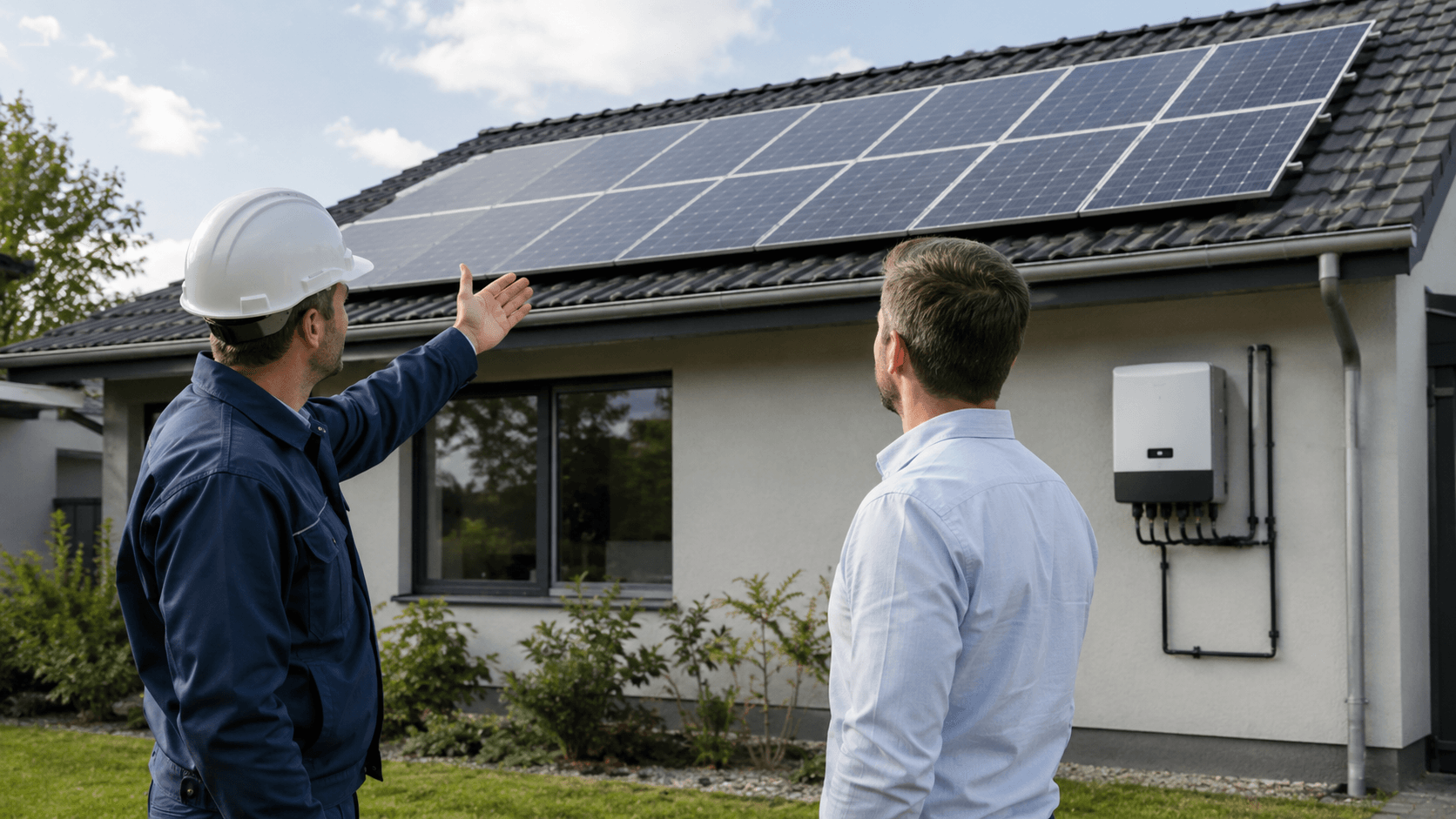
Thinking about going solar but not sure what “solar PV system” actually means, or which type suits your property? You’re not alone — with Malaysia’s growing number of solar programmes and incentives, it’s easy to get lost in the terminology before you’ve even had a chance to compare your options.
Key Takeaways
Solar photovoltaic systems are the technology behind most rooftop solar installations seen on Malaysian homes, factories, warehouses and commercial buildings.
Rather than generating electricity from heat, a solar photovoltaic system — commonly shortened to a solar PV system — converts sunlight directly into electrical energy. Solar panels generate direct current (DC) electricity, while an inverter converts it into alternating current (AC) that can be used by the property.
Understanding how the complete system works is important because solar panels are only one part of a solar installation. Inverters, mounting structures, electrical protection, metering and system design all contribute to how safely and efficiently the system performs.
A solar photovoltaic system, commonly called a solar PV system, is an integrated energy system that converts sunlight directly into electricity.
The photovoltaic process begins inside each solar PV panel. Photovoltaic cells — usually made from semiconductor materials such as silicon — absorb energy from sunlight and generate direct current (DC) electricity. An inverter then converts that DC electricity into alternating current (AC) electricity that can be used by homes, offices, factories and other buildings.
A complete solar photovoltaic system typically includes:
This means a solar PV panel and a solar PV system are not the same thing. The panel is the electricity-generating component, while the solar PV system includes all the equipment required to generate, convert, manage and deliver that electricity safely.
At the cell level: Each PV cell consists of two layers of silicon treated with different chemical impurities — one positively charged (P-type), one negatively charged (N-type) — forming a P-N junction. When photons from sunlight strike the cell, they knock electrons loose from their parent atoms. These energised electrons flow toward the N-type layer, creating direct current (DC) — the native output of every solar cell.
A single cell produces only around 0.5 volts, so dozens are connected and sealed within a weatherproof frame to form a panel (module). Panels are then wired together into an array — series wiring increases voltage, parallel wiring increases current — allowing designers to reach the exact specification needed, whether a 5 kWp residential system or a 1,000 kWp commercial array.
At the system level, throughout the day:
At the system level, the process is simpler to understand:
Sunlight → Solar PV Panels → DC Electricity → Solar Inverter → AC Electricity → Home or Business
A complete solar photovoltaic system is more than just panels on a roof. Each component plays a specific and essential role.
A solar PV panel contains multiple photovoltaic cells connected together inside a weather-resistant module. When sunlight reaches these cells, the photovoltaic effect produces DC electricity that can then be converted by the inverter for use within the property.
Modern solar PV panels used in Malaysian residential, commercial and industrial installations are commonly based on monocrystalline technology because of their relatively high efficiency and ability to generate more electricity from limited roof space.
However, panel efficiency alone does not determine whether a solar photovoltaic system will perform well. Overall generation also depends on:
For this reason, the best solar PV system is normally designed around the property and its energy requirements rather than selected based on solar panel specifications alone.
Since panels produce DC and Malaysian homes/businesses run on AC (240V/50Hz), an inverter is essential. Three main configurations are used locally:
Racking and mounting hardware secures panels at the correct angle and orientation. In Malaysia, south- or west-facing orientations at a 10–20 degree tilt typically optimise energy capture. Mounting must be engineered to withstand local wind loads and tropical rainfall, with all roof penetrations properly waterproofed.
A generation meter records how much electricity your system produces. For grid-connected systems under Solar ATAP or SELCO, TNB installs a bi-directional (import/export) meter to measure both grid consumption and exported solar energy.
DC and AC cabling, surge protection devices, circuit breakers, and earthing systems form the electrical backbone, and must be specified and installed by a qualified electrical engineer to meet Malaysian electrical standards.
A BESS stores excess solar energy generated during peak sun hours for use at night or during outages, increasing self-consumption and energy resilience.
Sunlight → Solar PV Panels → DC Electricity → Inverter → AC Electricity → Home or Business
During daylight hours:
The same basic photovoltaic technology is used in both residential and commercial solar PV systems. What changes is the system capacity, engineering design, electrical configuration and energy-management strategy.
Not all solar system malaysia installations are built the same way. The right type depends on your connection to the grid, your budget, and how much backup power you want during an outage.
| System Type | Grid Connection | Battery Storage | Best For |
|---|---|---|---|
| On-Grid | Yes | No | Homes and businesses prioritising solar self-consumption and lower electricity purchases |
| Off-Grid | No | Yes | Remote properties without reliable grid access |
| Hybrid | Yes | Yes | Properties wanting bill savings plus backup power during outages |
Each type has its own trade-offs in cost, complexity, and energy independence. For a deeper breakdown of how these systems compare — including which one suits different property types — see our dedicated guide on on-grid, off-grid, and hybrid solar systems.
Malaysia has different frameworks for installing and operating solar photovoltaic systems depending on the consumer and system configuration.
Solar ATAP, which commenced on 1 January 2026, allows eligible consumers in Peninsular Malaysia to install solar PV systems primarily for self-consumption while exporting eligible surplus solar electricity to the grid under the programme’s applicable credit mechanism. Solar ATAP continues Malaysia’s consumer rooftop solar development following the conclusion of the previous Net Energy Metering (NEM) programme in June 2025.
SELCO (Self-Consumption) is designed for solar PV installations where the electricity generated is primarily consumed within the premises rather than exported under an energy-offset arrangement.
The appropriate programme and solar PV system design depend on factors such as consumer category, system capacity, electricity usage and grid-connection requirements.
While the underlying technology is the same, residential and commercial solar pv systems differ in scale and design priorities.
Residential systems are typically smaller, designed around a household’s average monthly usage, and focused on maximising bill savings with minimal disruption to the home. Explore our residential solar solutions for a closer look at what’s involved for homeowners.
Commercial and industrial systems are built for higher energy demand, often incorporating larger arrays, more complex load calculations, and access to incentives like GITA. For businesses and facilities, our commercial and industrial solar page covers the process from consultation through commissioning.
Some properties — particularly businesses wanting resilience against outages — also pair their solar system with a battery energy storage system (BESS) to store surplus energy for later use.
|
Term |
What It Means |
|
kWp (kilowatt-peak) |
The rated power output of a solar system under standard test conditions |
|
kWh (kilowatt-hour) |
The unit of energy used to measure electricity generated or consumed |
|
DC (Direct Current) |
The type of electricity produced by solar PV panels |
|
AC (Alternating Current) |
The type of electricity used in homes and buildings |
|
Inverter |
Device that converts DC from solar panels to usable AC electricity |
|
Net Energy Metering |
A billing mechanism crediting exported solar energy against grid imports |
|
Solar ATAP |
SEDA Malaysia’s residential rooftop solar programme (effective January 2026) |
|
BESS |
Battery Energy Storage System — stores solar energy for later use |
|
EPCC |
Engineering, Procurement, Construction and Commissioning — the full-service model used by Ray Go Solar |
Choosing between solar photovoltaic systems should be based on how the property actually uses electricity, not simply the number or wattage of solar PV panels.
Consider:
Ray Go Solar designs solar PV systems based on site conditions, electricity consumption and project objectives, providing integrated Engineering, Procurement, Construction and Commissioning (EPCC) support for residential, commercial and industrial projects.
With over 13 years of experience, SEDA recognition, ISPQ-certified engineers, and a portfolio spanning hundreds of residential, commercial, and industrial projects across Malaysia, Ray Go Solar is your trusted partner for solar photovoltaic systems that are designed correctly, installed safely, and supported for the long term.
Get a free solar assessment today and find out exactly how much your property could generate — and save.
A solar photovoltaic system is an integrated setup that converts sunlight into usable electricity. It typically includes solar PV panels, an inverter, mounting structures, cabling, protection equipment and monitoring. Battery storage may also be included depending on the system design.
A solar PV panel is a module containing photovoltaic cells that convert sunlight into direct current electricity through the photovoltaic effect. Multiple solar PV panels are normally connected together to form the generating array within a complete solar PV system.
Solar PV systems are typically designed for a long operational lifespan, with panels retaining a significant portion of their original efficiency throughout that period.
A solar PV panel is only the electricity-generating module. A solar PV system includes the panels plus the inverter, mounting system, electrical equipment, monitoring and other components needed to deliver usable electricity.
Yes. The same photovoltaic principle is used for both. Residential solar PV systems are generally smaller and designed around household consumption, while commercial and industrial systems have larger capacities and more complex engineering and energy-management requirements.
For most homes and businesses with reasonable daytime electricity usage, a solar PV system offers meaningful long-term savings, particularly when paired with NEM, Solar ATAP, SELCO, or GITA incentives.
An on-grid system connects directly to the grid without battery storage, while a hybrid system adds battery backup for use during outages or periods of low solar generation.
Yes — grid-connected systems generally require registration through SEDA-accredited installers and coordination with TNB for grid connection and NEM registration.


